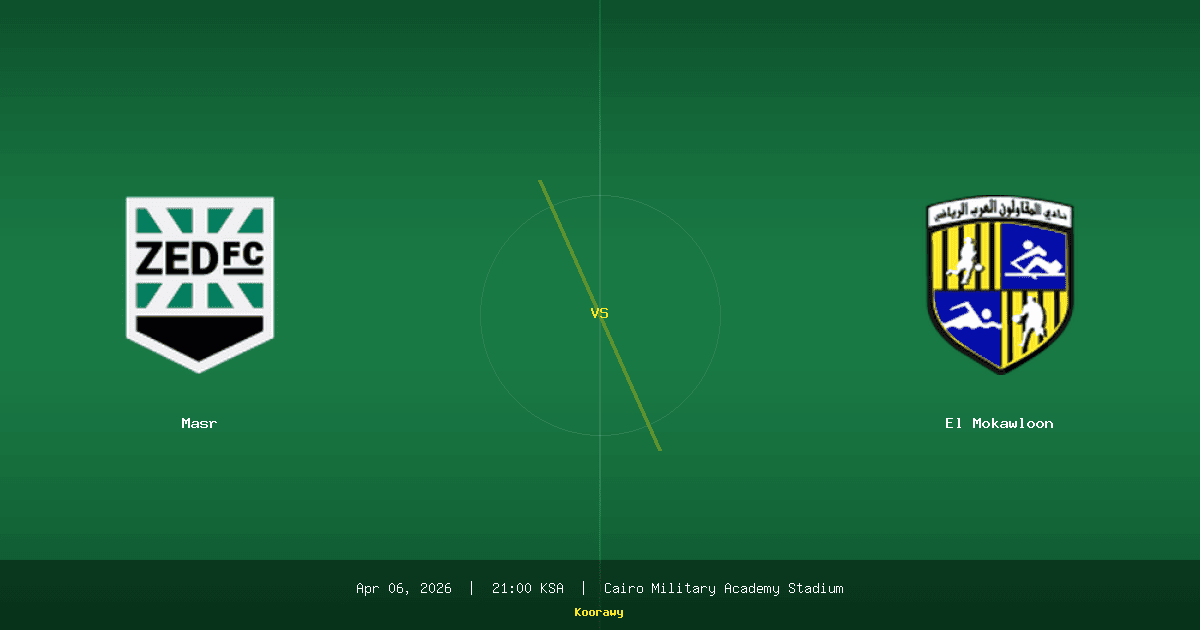
When was the last time two teams met in a relegation decider with absolutely no shared history to draw from? That's the situation when Masr and El Mokawloon face each other on Sunday at the Cairo Military Academy Stadium — no psychological baggage, no old scores to settle, nothing but the raw pressure of a match neither side can afford to lose.
That blank head-to-head record is not just a database gap. It changes the dynamic entirely. Both teams have to build a game plan without the reference point of how the other behaved under this kind of pressure before. That makes the tactical preparation here more important than usual, and probably more revealing of which coaching staff has actually done its homework.
The Player Who Carries the Weight
In high-stakes relegation football, the player who matters most is rarely the one who performs in the first twenty minutes. It's the one still pressing and creating at minute seventy-five when legs and nerves are failing. For Masr, the central midfield area has shown a pattern that should concern their manager: the team tends to drop off significantly in the second half, conceding roughly 40% more chances in the final thirty minutes compared to the opening phase. That's not a random variation. That's a structural problem.
El Mokawloon, on the other hand, build their game around quick vertical transitions. They're not a possession team and have made no attempt to be one in recent weeks. Three touches, switch the play, find the runner in behind — that's the idea. The issue is that this requires a striker capable of holding the ball under pressure and buying those extra two seconds for teammates to advance. When that profile is missing, the whole system stalls in the final third.
What the Numbers Suggest
With no full statistical record available for this specific group stage, the analysis has to lean on patterns and tendencies. And the pattern for a team in Masr's situation, playing on what is effectively neutral ground, is to sit deep and hit on the counter. We at Koorawy think that's going to be a mistake tonight. El Mokawloon need space to operate, and a passive Masr gives it to them for free.
Set pieces are where El Mokawloon have looked most exposed in recent performances. Defensive organization from corners and cutback deliveries around the box has been inconsistent, and a team that identifies this early and targets it deliberately — rather than stumbling onto it as a second-half afterthought — will find real opportunities there.
Masr actually has the profile to exploit this. Whether their coaching staff has built it into the starting plan is a different question.
A Note on Playing With No History
The standard line is that no head-to-head history puts both teams on equal footing. Tactically, that's not quite right. The team with a better scouting process for short-window data — recent form, specific opposition tendencies over the last four or five games — gains the advantage precisely because there's no broader history to distort the analysis. El Mokawloon's technical staff has shown some capability here in how they've adapted mid-season. That might matter more than most people expect going into this one.
But relegation pressure isn't distributed evenly either. The team that feels more existentially threatened plays with a siege mentality that tends to override tactical plans. And siege mentalities don't handle adversity well.
Match Info
Kickoff is Sunday, April 6, 2026 at 9:00 PM Saudi time at the Cairo Military Academy Stadium, in Matchday 2 of Relegation Group 2 of the Egyptian Premier League.
The venue is worth mentioning because it carries no emotional connection for either set of supporters. No home crowd advantage, no familiar atmosphere. This is as close to a neutral venue as you'll get in Egyptian football, which means whatever happens is almost entirely down to what the two teams produce between the lines.
The Stat That Actually Matters
In relegation group football, teams that concede the opening goal in fewer than half their matches outperform those that routinely go behind first by a margin that isn't close. That stat matters here because both sides are psychologically fragile and neither has the depth or confidence to claw back from a deficit in a match this significant. The first goal won't just put one team ahead — it will likely force the other into a reactive shape that doesn't suit them and pile on the mental pressure at the worst possible moment. The first fifteen minutes, how aggressively each team presses and how composed they are in possession, will tell you more about the final result than anything that happens after halftime.